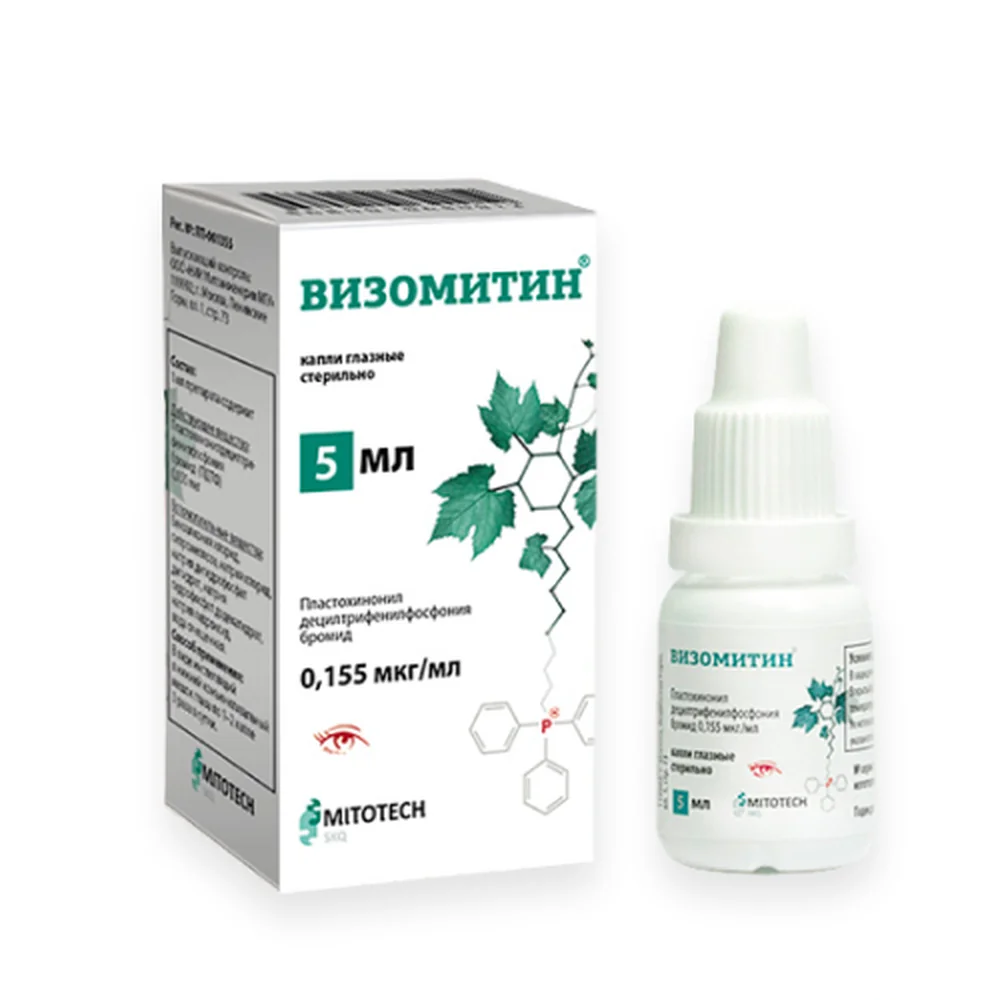
These statements have not been evaluated by the Food and Drug Administration (FDA). If you are searching to buy Visomitin SKQ1 eye drops USA, please note that Aptechka.store provides 100% original Visomitin SKQ1 eye drops for personal use. This product is not intended to diagnose, treat, cure, or prevent any disease. Always consult your attending physician strictly before starting any new protocol.
Product Properties:
Driving & Machinery
Use caution with tasks requiring rapid psychomotor reactions (e.g., driving or operating machinery)
Storage Temp
Store protected from light at or below 77°F (25°C)
Nursing Mothers
Contraindicated during breastfeeding
Pregnancy
Contraindicated during pregnancy
Allergy Sufferers
Contraindicated with hypersensitivity to the active ingredient or any excipient
Directions:
DOSAGE AND ADMINISTRATION
- Dry Eye Syndrome: Instill 1–2 drops into the conjunctival sac 3 times daily. The duration of the treatment course is determined by the physician based on the severity of the condition.
- Early-Stage Age-Related Cataract: Instill 1–2 drops into the conjunctival sac 3 times daily. The duration of the treatment course is 6 months.
Note: During therapy, regular supervision by an ophthalmologist is required to assess disease progression and determine the need for continued conservative treatment.
INDICATIONS AND USAGE
- Dry Eye Syndrome
- Early-stage age-related cataract
DESCRIPTION AND COMPOSITION
Each 1 mL of solution contains:
- Active Ingredient: Plastoquinonyldecyltriphenylphosphonium bromide (PDTF) – 0.155 mcg
- Inactive Ingredients: Benzalkonium chloride (0.1 mg), hypromellose (2 mg), sodium chloride (9 mg), sodium dihydrogen phosphate dihydrate (0.81 mg), sodium hydrogen phosphate dodecahydrate (1.16 mg), 1 M sodium hydroxide solution (to adjust pH to 6.3 – 7.3), and purified water (qs to 1 mL).
CONTRAINDICATIONS
- Hypersensitivity to any component of the formulation.
- Patients under 18 years of age.
PREGNANCY AND LACTATION
Adequate and well-controlled studies in pregnant and breastfeeding women have not been conducted. Use of this drug during pregnancy is not recommended. If administration is deemed necessary during lactation, breastfeeding should be discontinued for the duration of the treatment.
WARNINGS AND PRECAUTIONS
Effect on the Ability to Drive and Use Machinery:
If transient blurred vision occurs after application, do not drive or engage in activities requiring heightened concentration and attention until vision is fully restored.
If transient blurred vision occurs after application, do not drive or engage in activities requiring heightened concentration and attention until vision is fully restored.
HOW SUPPLIED (PACKAGING)
Ophthalmic solution at a concentration of 0.155 mcg/mL supplied in 5 mL polyethylene vials equipped with dropper stoppers and screw caps. Each vial, along with the package insert, is packaged in a cardboard carton.
ADVERSE REACTIONS
- General: Allergic reactions.
- Sensory Organs: Transient burning and stinging sensation in the eyes immediately after instillation may occur.
REPORTING: Report to your physician any adverse reactions, including those not mentioned in this package insert, as well as any changes in laboratory parameters observed during therapy.
PHARMACOTHERAPEUTIC GROUP
Keratoprotective agent
DRUG INTERACTIONS
If necessary, this medication may be used concurrently with other ophthalmic drops. In such cases, the interval between instillations of different products should be at least 5 minutes.
CLINICAL PHARMACOLOGY
Pharmacodynamics:
Plastoquinonyldecyltriphenylphosphonium bromide (PDTF) is a plastoquinone derivative linked via a C10 alkyl chain to a triphenylphosphine moiety. At low (nanomolar) concentrations, PDTF exhibits high antioxidant activity. It also stimulates tear production and epithelialization, and helps enhance the stability of the tear film.
Plastoquinonyldecyltriphenylphosphonium bromide (PDTF) is a plastoquinone derivative linked via a C10 alkyl chain to a triphenylphosphine moiety. At low (nanomolar) concentrations, PDTF exhibits high antioxidant activity. It also stimulates tear production and epithelialization, and helps enhance the stability of the tear film.
One of the contributing factors to age-related cataract development is the damaging effect of ultraviolet (UV) radiation, which initiates photo-oxidation processes leading to the denaturation of crystallins, the main structural proteins of the eye lens. The primary defense mechanism of eye tissues against UV radiation is the tear fluid, which absorbs UV light in the 240–320 nm range and neutralizes it via its inherent antioxidant components.
Preclinical studies indicate that the anti-cataract effect of Visomitin® is associated with increased expression of major lens proteins (α-crystallins), restoration of the lens epithelium, and activation of cellular energy processes within the lens. Clinical study data demonstrate that patients with age-related cataracts using Visomitin® exhibited increased antioxidant activity in their tear fluid.
Pharmacokinetics:
Pharmacokinetic studies in humans have not been conducted. In preclinical animal studies, the distribution of PDTF in organs and tissues was observed within 48 hours following intravenous and intragastric administration. PDTF was found to reach its highest concentrations in kidney, liver, and heart tissues within 1 hour post-administration. PDTF undergoes relatively rapid enzymatic cleavage and covalent binding to proteins.
Pharmacokinetic studies in humans have not been conducted. In preclinical animal studies, the distribution of PDTF in organs and tissues was observed within 48 hours following intravenous and intragastric administration. PDTF was found to reach its highest concentrations in kidney, liver, and heart tissues within 1 hour post-administration. PDTF undergoes relatively rapid enzymatic cleavage and covalent binding to proteins.
STORAGE AND HANDLING
Store at 2°C to 8°C (36°F to 46°F).
DOSAGE FORM DESCRIPTION
A clear or slightly opalescent, colorless or faintly colored liquid.
OVERDOSAGE
There are no reported data on overdose following topical ophthalmic application.
Manufacturer
Firn M LLC / Research Institute of Mitoengineering, Lomonosov Moscow State University LLC
Primary Packaging
Vial
Dosage Form
Ophthalmic solution (Eye drops)
Strength
0.155 mcg/mL
Shelf Life
Extended shelf life (Note: refer to packaging for exact expiration date)
References:
- SKQ1, wikipedia.com
- “Patent Claims”. Scientific American. 1 (20): 324–326. 1859-11-12. doi:10.1038/scientificamerican11121859-324. ISSN 0036-8733.
- ↑ US 9724313, Skulachev, Maxim V., “Pharmaceutical composition for use in medical and veterinary ophthalmology”, published 2019-02-26, assigned to Mitotech SA
- ↑ US 9328130, Skulachev, Vladimir Petrovich, “Method of treating organism by biologically active compounds specifically delivered into mitochondria, pharmaceutical composition required for the use of the method and a compound applicable for this purpose”, published 2016-05-03, assigned to Mitotech SA
- “ЕВРАЗИЙСКАЯ ПАТЕНТНАЯ ОРГАНИЗАЦИЯ (ЕАПО)”. www.eapo.org. Retrieved 2019-09-18.
- Liberman, E. A.; Topaly, V. P.; Tsofina, L. M.; Jasaitis, A. A.; Skulachev, V. P. (1969-06-14). “Mechanism of coupling of oxidative phosphorylation and the membrane potential of mitochondria”. Nature. 222 (5198): 1076–1078. Bibcode:1969Natur.222.1076L. doi:10.1038/2221076a0. ISSN 0028-0836. PMID 5787094. S2CID 4223514.
- Green, David E. (1974-04-30). “The electromechanical model for energy coupling in mitochondria”. Biochimica et Biophysica Acta (BBA) – Reviews on Bioenergetics. 346 (1): 27–78. doi:10.1016/0304-4173(74)90011-1. ISSN 0304-4173. PMID 4151654.
- Smith, R. A.; Porteous, C. M.; Coulter, C. V.; Murphy, M. P. (August 1999). “Selective targeting of an antioxidant to mitochondria”. European Journal of Biochemistry. 263 (3): 709–716. doi:10.1046/j.1432-1327.1999.00543.x. ISSN 0014-2956. PMID 10469134
Reviews
There are no reviews yet.