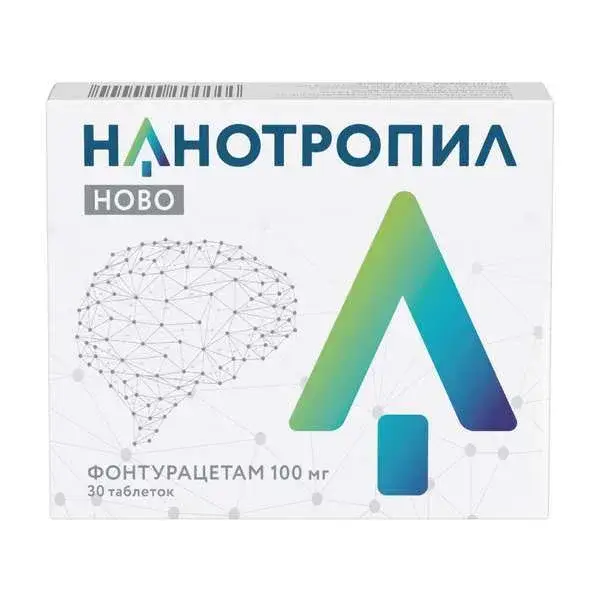
These statements have not been evaluated by the Food and Drug Administration (FDA). If you are searching to buy Nanotropil Novo (Fonturacetam) USA , please note that Aptechka.store provides 100% original Nanotropil Novo 100 mg 30 tablets for personal use. This product is not intended to diagnose, treat, cure, or prevent any disease. Always consult your attending physician strictly before starting any new protocol.
Product Properties
Nursing Mothers
Prohibited
Pregnancy
Prohibited
Storage Temperature
Store protected from light at 36 °F - 86 °F (2С- 30С)
Allergy Alert
Use with caution (pyrrolidones)
Drivers
Prohibited (may cause drowsiness)
Directions
Pharmacotherapeutic Group
Nootropic agent.
Nootropic agent.
Indications
- CNS diseases of various origins accompanied by a decline in intellectual-mnemestic functions and decreased motor activity.
- Neurotic states manifesting as memory impairment.
- Learning process disorders. Patients facing these cognitive difficulties often seek to buy nanotropil novo (fonturacetam) usa to support their neurological health.
- Psychoorganic syndromes manifesting as intellectual-mnestic impairments.
- Convulsive states.
- Obesity (of alimentary-constitutional origin).
- Prevention of hypoxia, increasing stress resistance, and correcting the functional state of the body under extreme occupational conditions to prevent fatigue and boost mental and physical performance.
- Chronic alcoholism (to reduce intellectual-mnestic disorders).
Composition
1 tablet contains:
1 tablet contains:
- Active substance: Fonturacetam – 50.00 mg or 100.00 mg.
- Excipients: Povidone K-17, microcrystalline cellulose, sodium carboxymethyl starch, magnesium stearate. If you are looking to get this nootropic product, you can buy nanotropil novo (fonturacetam) usa from reliable online distributors.
Dosage Form
Round, flat-cylindrical tablets, white to white with a yellowish tint. The 50 mg dosage features a bevel, and the 100 mg dosage features both a bevel and a score line.
Round, flat-cylindrical tablets, white to white with a yellowish tint. The 50 mg dosage features a bevel, and the 100 mg dosage features both a bevel and a score line.
Pharmacodynamics
A nootropic drug with a pronounced antiamnestic effect that promotes memory consolidation, facilitates the learning process, increases the resistance of brain tissues to toxic influences, and possesses anticonvulsant activity. It positively affects metabolic processes, stimulates oxidation-reduction processes, and enhances the body’s energy potential through glucose utilization.
A nootropic drug with a pronounced antiamnestic effect that promotes memory consolidation, facilitates the learning process, increases the resistance of brain tissues to toxic influences, and possesses anticonvulsant activity. It positively affects metabolic processes, stimulates oxidation-reduction processes, and enhances the body’s energy potential through glucose utilization.
It increases the levels of norepinephrine, dopamine, and serotonin in the brain, does not affect GABA levels, does not bind to GABA-A or GABA-B receptors, and has no significant effect on spontaneous bioelectrical brain activity. It does not affect respiration or the cardiovascular system, exhibits a mild diuretic effect, and shows anorexigenic activity during course use.
The stimulating effect manifests as a moderate increase in motor reactions, enhancement of physical performance, and reduction of the sedative effects of ethanol and hexobarbital. The psychostimulating effect predominates in the ideational sphere. The adaptogenic effect is shown by increased body resistance to stress under excessive mental and physical strain, fatigue, hypokinesia, immobilization, and low temperatures. Improved vision (increased acuity, brightness, and visual fields) and enhanced blood supply to the lower extremities have been reported.
It stimulates antibody production in response to antigen introduction, indicating immunostimulating properties, while not contributing to immediate-type hypersensitivity. Course use does not lead to drug dependence, tolerance, or withdrawal syndrome. The effect manifests after a single dose, which is important for use in extreme conditions.
Pharmacokinetics
- Absorption: Rapidly absorbed. Absolute bioavailability after oral administration is 100%.
- Distribution: Penetrates various organs and tissues, easily crossing the blood-brain barrier. Maximum blood concentration (\(T_{max}\)) is reached in 1 hour.
- Metabolism: It is not metabolized in the body.
- Elimination: The elimination half-life (\(T_{1/2}\)) is 3–5 hours. It is excreted unchanged: approximately 40% via the kidneys and 60% with bile and sweat.
Contraindications
Hypersensitivity to fonturacetam or any excipient in the drug formulation. Pregnancy and breastfeeding. Age under 18 years (due to the lack of clinical data on efficacy and safety in this age group).
Hypersensitivity to fonturacetam or any excipient in the drug formulation. Pregnancy and breastfeeding. Age under 18 years (due to the lack of clinical data on efficacy and safety in this age group).
Use with Caution
In patients with severe organic liver and kidney lesions, severe arterial hypertension, advanced atherosclerosis, or a history of panic attacks or acute psychotic states with psychomotor agitation—due to the potential risk of exacerbating anxiety, panic, hallucinations, and delusions. Caution is also advised in patients with allergic reactions to pyrrolidone-group nootropics.
In patients with severe organic liver and kidney lesions, severe arterial hypertension, advanced atherosclerosis, or a history of panic attacks or acute psychotic states with psychomotor agitation—due to the potential risk of exacerbating anxiety, panic, hallucinations, and delusions. Caution is also advised in patients with allergic reactions to pyrrolidone-group nootropics.
Pregnancy and Breastfeeding
There are no data from randomized clinical trials of fonturacetam in pregnant women. Therefore, the use of the drug during pregnancy and breastfeeding is contraindicated.
There are no data from randomized clinical trials of fonturacetam in pregnant women. Therefore, the use of the drug during pregnancy and breastfeeding is contraindicated.
Dosage and Administration
Oral. Take immediately after a meal. The dose and duration of treatment should be determined by a physician. Dosages vary depending on the patient’s individual condition. The average single dose is 150 mg (ranging from 100 to 250 mg); the average daily dose is 250 mg (ranging from 200 to 300 mg). The maximum daily dose is 750 mg. It is recommended to take a daily dose up to 100 mg as a single dose in the morning hours, while doses above 100 mg should be divided into 2 doses. The duration of treatment can range from 2 weeks to 3 months, averaging 30 days. If necessary, the course may be repeated after 1 month.
Oral. Take immediately after a meal. The dose and duration of treatment should be determined by a physician. Dosages vary depending on the patient’s individual condition. The average single dose is 150 mg (ranging from 100 to 250 mg); the average daily dose is 250 mg (ranging from 200 to 300 mg). The maximum daily dose is 750 mg. It is recommended to take a daily dose up to 100 mg as a single dose in the morning hours, while doses above 100 mg should be divided into 2 doses. The duration of treatment can range from 2 weeks to 3 months, averaging 30 days. If necessary, the course may be repeated after 1 month.
For performance enhancement: 100–200 mg once daily in the morning for 2 weeks (for athletes—3 days). For patients with alimentary-constitutional obesity, the recommended duration of therapy is 30–60 days at a dose of 100–200 mg once daily (in the morning hours). It is not recommended to take the drug later than 3:00 PM. Many individuals who travel or work demanding schedules choose to buy nanotropil novo (fonturacetam) usa to maintain their focus and productivity.
Side Effects
Insomnia (if taken later than 3:00 PM). In some patients, psychomotor agitation, skin flushing, a sensation of warmth, and increased blood pressure may occur during the first 1–3 days of administration.
Insomnia (if taken later than 3:00 PM). In some patients, psychomotor agitation, skin flushing, a sensation of warmth, and increased blood pressure may occur during the first 1–3 days of administration.
Overdose
No cases of overdose have been reported. Treatment: symptomatic therapy.
No cases of overdose have been reported. Treatment: symptomatic therapy.
Drug Interactions
Fonturacetam can potentiate the effects of CNS stimulants and other nootropic drugs. Fonturacetam exhibits pronounced antagonism against the cataleptic action of neuroleptics and reduces the hypnotic effect of ethanol and hexobarbital.
Fonturacetam can potentiate the effects of CNS stimulants and other nootropic drugs. Fonturacetam exhibits pronounced antagonism against the cataleptic action of neuroleptics and reduces the hypnotic effect of ethanol and hexobarbital.
Special Instructions
In cases of excessive psychoemotional exhaustion against a background of stress, fatigue, or chronic insomnia, a single dose on the first day may trigger a sharp need for sleep. For outpatients, it is recommended to start the treatment course on non-working days.
In cases of excessive psychoemotional exhaustion against a background of stress, fatigue, or chronic insomnia, a single dose on the first day may trigger a sharp need for sleep. For outpatients, it is recommended to start the treatment course on non-working days.
Effects on Ability to Drive and Operate Machinery
Caution should be exercised when driving vehicles and operating machinery, especially during the first days of intake, given the potential occurrence of drowsiness (see “Special Instructions”). For safety reasons, consumers should ensure they buy nanotropil novo (fonturacetam) usa only from verified sources to guarantee product authenticity.
Caution should be exercised when driving vehicles and operating machinery, especially during the first days of intake, given the potential occurrence of drowsiness (see “Special Instructions”). For safety reasons, consumers should ensure they buy nanotropil novo (fonturacetam) usa only from verified sources to guarantee product authenticity.
Storage Temperature
Store between 2℃ and 30℃.
Store between 2℃ and 30℃.
Packaging and Dosage Forms
Tablets, 100 mg – 10 tablets per blister pack, enclosed in a cardboard box along with the instruction leaflet. Before starting a regimen, make sure to buy nanotropil novo (fonturacetam) usa in the correct dosage form prescribed by your healthcare provider.
Tablets, 100 mg – 10 tablets per blister pack, enclosed in a cardboard box along with the instruction leaflet. Before starting a regimen, make sure to buy nanotropil novo (fonturacetam) usa in the correct dosage form prescribed by your healthcare provider.
References
- Gromova OA, Torshin IY (2024). “Farmakologičeskie èffekty fonturacetama (Aktitropil) i perspektivy ego kliničeskogo primenenija” [Pharmacological effects of fonturacetam (Actitropil) and prospects for its clinical use]. Zh Nevrol Psikhiatr Im S S Korsakova [S.S. Korsakov Journal of Neurology and Psychiatry] (in Russian). 124 (8): 21–31. doi:10.17116/jnevro202412408121. PMID 39269293.
- Malykh AG, Sadaie MR (February 2010). “Piracetam and piracetam-like drugs: from basic science to novel clinical applications to CNS disorders”. Drugs. 70 (3): 287–312. doi:10.2165/11319230-000000000-00000. PMID 20166767.
- “Fonturacetam” (PDF). Archived from the original (PDF) on 2022-11-26.
- Veinberg G, Vavers E, Orlova N, Kuznecovs J, Domracheva I, Vorona M, et al. (2015). “Stereochemistry of phenylpiracetam and its methyl derivative: improvement of the pharmacological profile”. Chemistry of Heterocyclic Compounds. 51 (7): 601–606. doi:10.1007/s10593-015-1747-9. ISSN 0009-3122.
Phenylpiracetam was originally designed as a nootropic drug for the sustenance and improvement of the physical condition and cognition abilities of Soviet space crews.2 Later, especially during the last decade, phenylpiracetam was introduced into general clinical practice in Russia and in some Eastern European countries. The possible target receptors and mechanisms for the acute activity of this drug remained unclear, until very recently it was found that (R)-phenylpiracetam (5) (MRZ-9547) is a selective dopamine transporter inhibitor that moderately stimulates striatal dopamine release.19
- Voronina TA (2023). “Cognitive Impairment and Nootropic Drugs: Mechanism of Action and Spectrum of Effects”. Neurochemical Journal. 17 (2). Pleiades Publishing Ltd: 180–188. doi:10.1134/s1819712423020198. ISSN 1819-7124.
Phenylpiracetam, a phenyl analogue of piracetam (trade names: phenotropil, carphedon, and phenylpiracetam), was developed at the Institute of Biomedical Problems as a new generation psychostimulant that can increase the mental and physical performance of astronauts at various stages of space flights. It was experimentally established that phenylpiracetam improves learning and memory, has an antiamnesic effect, activates operant behavior, has anxiolytic, antiasthenic, and anticonvulsant effects, weakens the sedative effect of benzodiazepines, increases resistance to cold, and improves sleep [29–31]. In a model of cerebral ischemia, phenylpiracetam improves cognitive functions, reduces manifestations of neurological deficit, and is superior in effectiveness to piracetam [32, 33]. It has been shown that phenylpiracetam does not bind to GABA-A, GABA-B and dopamine receptors, or 5-HT2 serotonin receptor, but is a synaptic transmission modulator and binds to α4β2 nicotinic acetylcholine receptors in the cerebral cortex (IC50 = 5.86 μm) [34, 35].
- Sommer S, Danysz W, Russ H, Valastro B, Flik G, Hauber W (December 2014). “The dopamine reuptake inhibitor MRZ-9547 increases progressive ratio responding in rats”. The International Journal of Neuropsychopharmacology. 17 (12): 2045–2056. doi:10.1017/S1461145714000996. PMID 24964269.
Here, we tested the effects of MRZ-9547 […], and its l-enantiomer MRZ-9546 on effort-related decision making in rats. The racemic form of these compounds referred to as phenotropil has been shown to stimulate motor activity in rats (Zvejniece et al., 2011) and enhance physical capacity and cognition in humans (Malykh and Sadaie, 2010). […] MRZ-9547 turned out to be a DAT inhibitor as shown by displacement of binding of [125I] RTI-55 (IC50 = 4.82 ± 0.05 μM, n=3) to human recombinant DAT expressed in CHO-K1 cells and inhibition of DA uptake (IC50 = 14.5 ± 1.6 μM, n=2) in functional assays in the same cells. It inhibited norepinephrine transporter (NET) with an IC50 of 182 μM (one experiment in duplicate). The potencies for the l-enantiomer MRZ-9546 were as follows: DAT binding (Ki = 34.8 ± 14.8 μM, n=3), DAT function (IC50 = 65.5 ± 8.3 μM, n=2) and NET function (IC50 = 667 μM, one experiment performed in duplicate).
- Gouliaev AH, Senning A (May 1994). “Piracetam and other structurally related nootropics”. Brain Res Brain Res Rev. 19 (2): 180–222. doi:10.1016/0165-0173(94)90011-6. PMID 8061686.
As mentioned above, no commonly accepted mechanism for the racetam nootropics has yet been established, They do not seem to act on any well characterised receptor site with the exception of nefiracetam which has high affinity for GABA, receptors (see Table 1). […] Receptor: GABAA. Receptor ligand: [3H]muscimolA. Compound: nefiracetam. IC50: 8.5 nMB. Refs.: 222. […] From Table 1 it is, however, evident that the piracetam-like nootropics do not exhibit high affinity for any of the receptor types tested so far (except for nefiracetam, which shows some activity at GABAA receptors)
- Bobkov Iu, Morozov IS, Glozman OM, Nerobkova LN, Zhmurenko LA (April 1983). “[Pharmacological characteristics of a new phenyl analog of piracetam–4-phenylpiracetam]”. Biull Eksp Biol Med (in Russian). 95 (4): 50–53. doi:10.1007/BF00838859. PMID 6403074.
- “MRZ 9547”. AdisInsight. 4 November 2017. Retrieved 11 August 2024.
- “Фенилпирацетам (Phenylpiracetam)”. АИПСИН (in Russian). Retrieved 1 January 2026.
- Kim S, Park JH, Myung SW, Lho DS (November 1999). “Determination of carphedon in human urine by solid-phase microextraction using capillary gas chromatography with nitrogen-phosphorus detection”. The Analyst. 124 (11): 1559–1562. Bibcode:1999Ana…124.1559K. doi:10.1039/a906027h. PMID 10746314.
- Savchenko AI, Zakharova NS, Stepanov IN (2005). “[The phenotropil treatment of the consequences of brain organic lesions]”. Zhurnal Nevrologii I Psikhiatrii imeni S.S. Korsakova. 105 (12): 22–26. PMID 16447562.
- Lybzikova GN, Iaglova Zh, Kharlamova Iu (2008). “[The efficacy of phenotropil in the complex treatment of epilepsy]”. Zh Nevrol Psikhiatr Im S S Korsakova (in Russian). 108 (2): 69–70. PMID 18646385.
- Kalinskiĭ PP, Nazarov VV (2007). “[Use of phenotropil in the treatment of asthenic syndrome and autonomic disturbances in the acute period of mild cranial brain trauma]”. Zh Nevrol Psikhiatr Im S S Korsakova (in Russian). 107 (2): 61–63. PMID 18689001.
- Gustov AA, Smirnov AA, Korshunova Iu, Andrianova EV (2006). “[Phenotropil in the treatment of vascular encephalopathy]”. Zh Nevrol Psikhiatr Im S S Korsakova (in Russian). 106 (3): 52–53. PMID 16608112.
- “Phenotropil®”. АО «Валента Фарм» (in Russian). Retrieved 27 September 2024.
- Molina-Carballo A, Checa-Ros A, Muñoz-Hoyos A (July 2016). “Treatments and compositions for attention deficit hyperactivity disorder: a patent review”. Expert Opin Ther Pat. 26 (7): 799–814. doi:10.1080/13543776.2016.1182989. PMID 27138211.
The racetams have different activities [e.g., phenylpiracetam is a stimulant developed and marketed in Russia, piracetam is a nootropic, and levetiracetam is widely used as an anticonvulsant (Figure 17)].
- Gualtieri F, Manetti D, Romanelli MN, Ghelardini C (2002). “Design and study of piracetam-like nootropics, controversial members of the problematic class of cognition-enhancing drugs”. Curr Pharm Des. 8 (2): 125–138. doi:10.2174/1381612023396582. PMID 11812254.
In general, piracetam-like nootropics show no affinity for the most important central receptors (Ki > 10 μM). A modest affinity for muscarinic receptors is shown by aniracetam (Ki = 4.4 μM [58]) and nebracetam (Ki = 6.3 μM [61]). Nefiracetam is the only one showing affinity in the nanomolar range (Ki = 8.5 nM on the GABAA receptor [58]). […] Nefiracetam (chart (1)) is awaiting approval. It presents a variety of pharmacological actions as it is reported to activate the cholinergic, GABAergic and other monaminergic systems and to modulate N-type calcium channels [78-81].
- Narahashi T, Moriguchi S, Zhao X, Marszalec W, Yeh JZ (November 2004). “Mechanisms of action of cognitive enhancers on neuroreceptors”. Biol Pharm Bull. 27 (11): 1701–1706. doi:10.1248/bpb.27.1701. PMID 15516710.
- Zvejniece L, Svalbe B, Vavers E, Makrecka-Kuka M, Makarova E, Liepins V, et al. (September 2017). “S-phenylpiracetam, a selective DAT inhibitor, reduces body weight gain without influencing locomotor activity”. Pharmacology, Biochemistry, and Behavior. 160: 21–29. doi:10.1016/j.pbb.2017.07.009. PMID 28743458. S2CID 13658335.
- EP application 20140000021, “Use of (r)-phenylpiracetam for the treatment of sleep disorders”, published 2015-07-08, assigned to Merz Pharma GmbH and Co KGaA
- Kovalev, G. I., Akhapkina, V. I., Abaimov, D. A., & Firstova, Y. Y. (2007). Phenotropil as receptor modulator of synaptic neurotransmission. Nervnye Bolezni, 4, 22–26. https://scholar.google.com/scholar?cluster=617408379890668058
- Zvejniece L, Zvejniece B, Videja M, Stelfa G, Vavers E, Grinberga S, et al. (October 2020). “Neuroprotective and anti-inflammatory activity of DAT inhibitor R-phenylpiracetam in experimental models of inflammation in male mice”. Inflammopharmacology. 28 (5): 1283–1292. doi:10.1007/s10787-020-00705-7. PMID 32279140. S2CID 215731963.
- Reith ME, Blough BE, Hong WC, Jones KT, Schmitt KC, Baumann MH, et al. (February 2015). “Behavioral, biological, and chemical perspectives on atypical agents targeting the dopamine transporter”. Drug Alcohol Depend. 147: 1–19. doi:10.1016/j.drugalcdep.2014.12.005. PMC 4297708. PMID 25548026.
- Hersey M, Bacon AK, Bailey LG, Coggiano MA, Newman AH, Leggio L, et al. (2021). “Psychostimulant Use Disorder, an Unmet Therapeutic Goal: Can Modafinil Narrow the Gap?”. Front Neurosci. 15 656475. doi:10.3389/fnins.2021.656475. PMC 8187604. PMID 34121988.
- Tanda G, Hersey M, Hempel B, Xi ZX, Newman AH (February 2021). “Modafinil and its structural analogs as atypical dopamine uptake inhibitors and potential medications for psychostimulant use disorder”. Curr Opin Pharmacol. 56: 13–21. doi:10.1016/j.coph.2020.07.007. PMC 8247144. PMID 32927246.
- Jordan CJ, Cao J, Newman AH, Xi ZX (November 2019). “Progress in agonist therapy for substance use disorders: Lessons learned from methadone and buprenorphine”. Neuropharmacology. 158 107609. doi:10.1016/j.neuropharm.2019.04.015. PMC 6745247. PMID 31009632.
- Nepal B, Das S, Reith ME, Kortagere S (2023). “Overview of the structure and function of the dopamine transporter and its protein interactions”. Front Physiol. 14 1150355. doi:10.3389/fphys.2023.1150355. PMC 10020207. PMID 36935752.
- Nguyen H, Cheng MH, Lee JY, Aggarwal S, Mortensen OV, Bahar I (2024). “Allosteric modulation of serotonin and dopamine transporters: New insights from computations and experiments”. Curr Res Physiol. 7 100125. doi:10.1016/j.crphys.2024.100125. PMC 11148570. PMID 38836245.
- Aggarwal S, Cheng MH, Salvino JM, Bahar I, Mortensen OV (June 2021). “Functional Characterization of the Dopaminergic Psychostimulant Sydnocarb as an Allosteric Modulator of the Human Dopamine Transporter”. Biomedicines. 9 (6): 634. doi:10.3390/biomedicines9060634. PMC 8227285. PMID 34199621.
- Hoy SM (November 2023). “Solriamfetol: A Review in Excessive Daytime Sleepiness Associated with Narcolepsy and Obstructive Sleep Apnoea”. CNS Drugs. 37 (11): 1009–1020. doi:10.1007/s40263-023-01040-5. PMID 37847434.
- Firstova YY, Abaimov DA, Kapitsa IG, Voronina TA, Kovalev GI (2011). “The effects of scopolamine and the nootropic drug phenotropil on rat brain neurotransmitter receptors during testing of the conditioned passive avoidance task”. Neurochemical Journal. 28 (2): 130–141. doi:10.1134/S1819712411020048. S2CID 5845024.
- Zhao X, Kuryatov A, Lindstrom JM, Yeh JZ, Narahashi T (April 2001). “Nootropic drug modulation of neuronal nicotinic acetylcholine receptors in rat cortical neurons”. Mol Pharmacol. 59 (4): 674–683. doi:10.1124/mol.59.4.674. PMID 11259610.
- Kadriu B, Musazzi L, Johnston JN, Kalynchuk LE, Caruncho HJ, Popoli M, et al. (December 2021). “Positive AMPA receptor modulation in the treatment of neuropsychiatric disorders: A long and winding road”. Drug Discov Today. 26 (12): 2816–2838. doi:10.1016/j.drudis.2021.07.027. PMC 9585480. PMID 34358693.
- Zvejniece L, Svalbe B, Veinberg G, Grinberga S, Vorona M, Kalvinsh I, et al. (November 2011). “Investigation into stereoselective pharmacological activity of phenotropil”. Basic & Clinical Pharmacology & Toxicology. 109 (5): 407–412. doi:10.1111/j.1742-7843.2011.00742.x. PMID 21689376.
- Antonova MI, Prokopov AA, Akhapkina VI, Berlyand AS (2003). “Experimental Pharmacokinetics of Phenotropyl in Rats”. Pharmaceutical Chemistry Journal. 37 (11). Springer Science and Business Media LLC: 571–572. doi:10.1023/b:phac.0000016064.51030.6f. ISSN 0091-150X.
- Tiurenkov IN, Bagmetov MN, Epishina VV (2007). “[Comparative evaluation of the neuroprotective activity of phenotropil and piracetam in laboratory animals with experimental cerebral ischemia]”. Eksperimental’naia i Klinicheskaia Farmakologiia. 70 (2): 24–29. PMID 17523446.
- “Fonturacetam”. PubChem. Retrieved 27 September 2024.
- Tiurenkov IN, Bagmetova VV, Shishkina AV, Berestovitskaia VM, Vasil’eva OS, Ostrogliadov ES (November 2010). “[Gender differences in action Fenotropil and its structural analog–compound RGPU-95 on anxiety-depressive behavior animals]”. Eksp Klin Farmakol (in Russian). 73 (11): 10–14. PMID 21254591.
- “Cebaracetam”. PubChem. Retrieved 1 October 2024.
- Vavers E, Zvejniece L, Maurice T, Dambrova M (2019). “Allosteric Modulators of Sigma-1 Receptor: A Review”. Front Pharmacol. 10 223. doi:10.3389/fphar.2019.00223. PMC 6433746. PMID 30941035.
- Zvejniece L, Vavers E, Svalbe B, Vilskersts R, Domracheva I, Vorona M, et al. (February 2014). “The cognition-enhancing activity of E1R, a novel positive allosteric modulator of sigma-1 receptors”. Br J Pharmacol. 171 (3): 761–771. doi:10.1111/bph.12506. PMC 3969087. PMID 24490863.
- Wang PL, Chan YX, Chang CC (2023). “New synthesis of β-aryl-GABA drugs”. Tetrahedron. 146 133648. Elsevier BV. doi:10.1016/j.tet.2023.133648. ISSN 0040-4020.
- “Фенотропил: закономерное лидерство” [Phenotropil: natural leadership]. Medi.ru (in Russian). Archived from the original on August 6, 2017. Retrieved July 24, 2023.
- Akhapkina VI, Akhapkin RV (2013). “[Identification and evaluation of the neuroleptic activity of phenotropil]”. Zh Nevrol Psikhiatr Im S S Korsakova (in Russian). 113 (7): 42–46. PMID 23994920.
- “List of Controlled Substances” (PDF). Division Control Division. Drug Enforcement Administration, U.S. Department of Justice. 8 February 2016. Archived from the original (PDF) on 17 April 2016. Retrieved 16 September 2013.
- Khatoon R, Alam MA, Sharma PK (2021). “Current approaches and prospective drug targeting to brain”. Journal of Drug Delivery Science and Technology. 61 102098. Elsevier BV. doi:10.1016/j.jddst.2020.102098. ISSN 1773-2247.
- Docherty JR (June 2008). “Pharmacology of stimulants prohibited by the World Anti-Doping Agency (WADA)”. Br J Pharmacol. 154 (3): 606–622. doi:10.1038/bjp.2008.124. PMC 2439527. PMID 18500382.
- Smith AC, Stavros C, Westberg K (2020). “Cognitive Enhancing Drugs in Sport: Current and Future Concerns”. Subst Use Misuse. 55 (12): 2064–2075. doi:10.1080/10826084.2020.1775652. PMID 32525422.
- “Prohibited List” (PDF). World Anti-Doping Agency (WADA). January 2017. p. 6.
- “Neurobiology and pharmacology of activational and effort-related aspects of motivation: rodent studies”. Current Opinion in Behavioral Sciences. 22: 114–120. doi:10.1016/j.cobeha.2018.01.026.
Several drugs that reverse the effects of tetrabenazine also can increase selection of high-effort PROG lever pressing when administered alone, including MSX-3 [27], and the DA transport blockers MRZ-9547 [26], bupropion [28], lisdexamfetamine [45], PRX-14040 [46], and GBR12909 [53].
Reviews
There are no reviews yet.